Visual software
AI visual inspection software
▶ Product Advantages
High performance and wide coverage
- Solving various complex testing problems:
Effectively addresses issues such as low contrast, numerous defect types, complex backgrounds, and small defect sizes.
Complex inspection scenario.
The minimum detectable size is 3 pixels, and as low as 2 pixels when the defect contrast is obvious.
- Adapting to high production line speed requirements:
Training with 100 images takes approximately 10 minutes; pixel-level defect detection is performed on a single image.
Defect classification takes less than 1 second and can be completed within 30ms.
- Support for small sample scenarios:
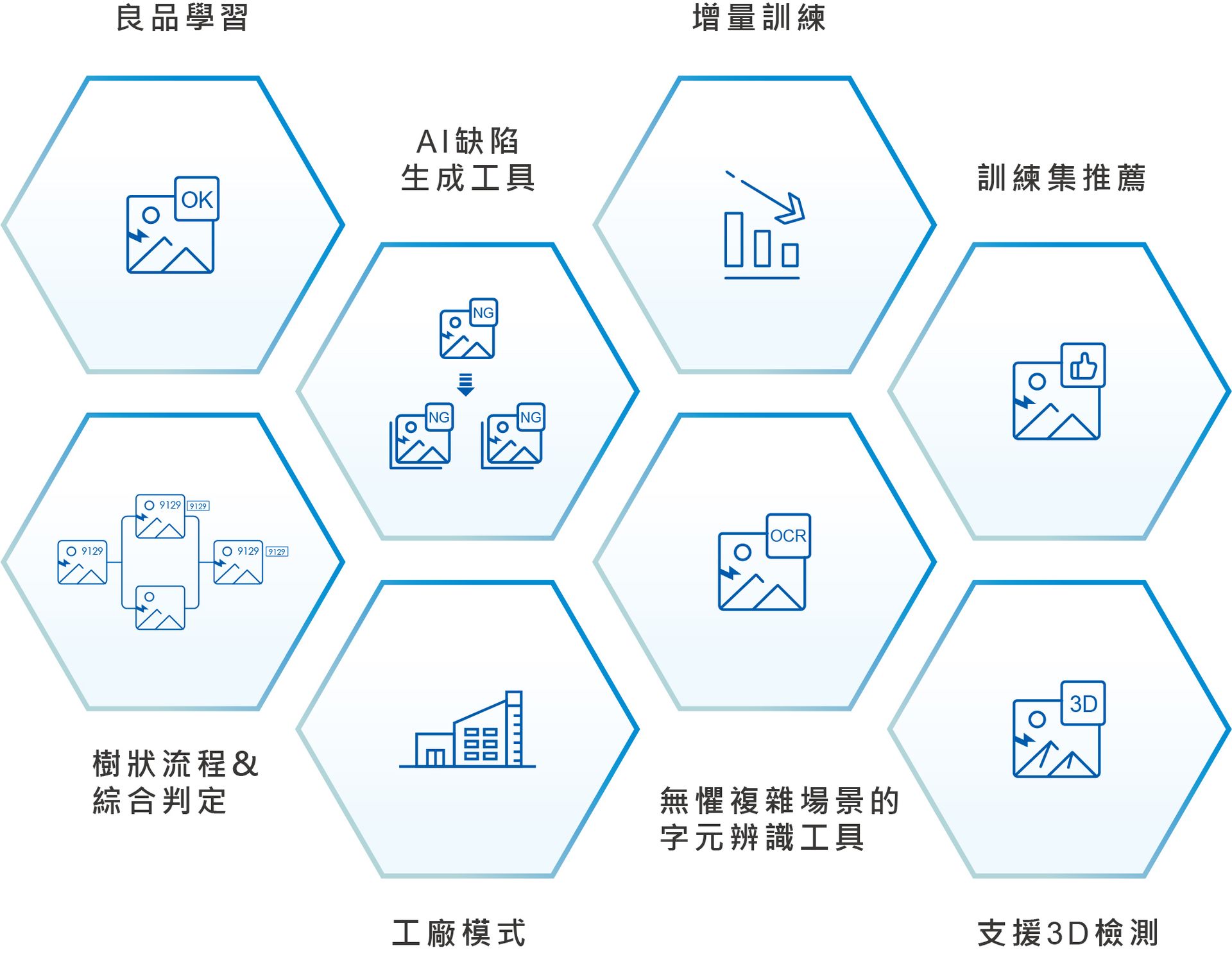
Built-in few-shot algorithm, supports good-product learning mode, accurately identifies single-class defects.
30-50 images are needed, or even no defective samples are needed.
Feature-rich and highly efficient to deploy
Helps to efficiently build high-quality models, improves deployment efficiency, and achieves an overall speedup.
65%-90%。
- Incremental training: Only new defective images need to be learned, shortening the model retraining time.
- Training set recommendation: Supports intelligent selection of effective data to improve model construction effectiveness and efficiency.
- Factory mode: By analogy with the actual production line model, the detection effect and time can be quickly identified to pinpoint the causes of missed or over-detected items and improve the efficiency of model validation.
Flexible secondary development and low overall cost
- It provides a standardized interface that is compatible with mainstream operating systems and commonly used industrial vision software.
- It supports multiple programming languages and allows for flexible secondary development for special scenarios.
- The system can detect multiple defect types in a single image and make comprehensive judgments without the need for secondary development, thus reducing time and labor costs.








division
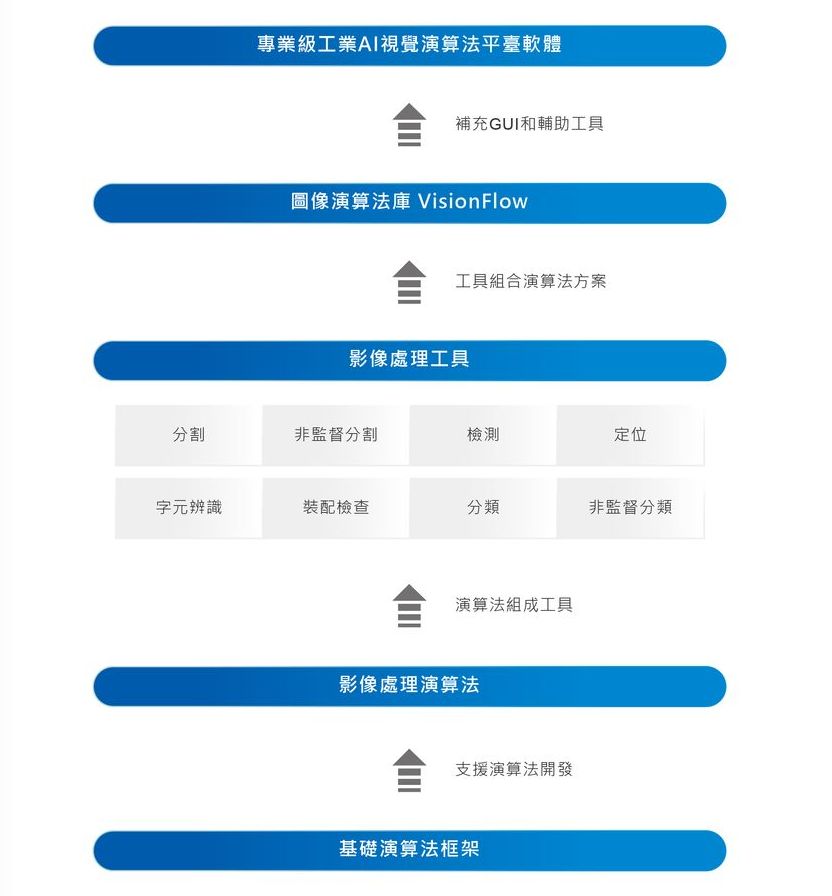
Pixel-level inspection of images accurately identifies the location, size, and type of defects.
Application scenarios: Detection of minor surface defects and defects in complex environments.
Unsupervised segmentation
All known and unknown defects can be detected at the pixel level using only images of good products, enabling rapid online verification.
Application scenarios: High production line yield, long sample collection cycle, and the possibility of unknown defects.
Detection
Perform regional-level inspections on images to accurately identify target objects or defects.
Application scenarios: multi-target detection, multi-type defect detection
position
Detect the category, location, size, and orientation of single or multiple targets in an image.
Application scenario: High-precision target positioning
Character recognition
Efficiently identify text in images.
Application scenarios: Overlapping/distorted/skewed character recognition, complex background character recognition, recognition of multiple fonts and text types.
Assembly inspection
The detection function checks whether the presence and quantity of targets within a fixed area meet the requirements.
Application scenario: Quickly verify whether the assembly meets the set standards.
Classification
Determine the category to which the entire image belongs.
Application scenarios: Defect classification, product sorting and grading
Unsupervised classification
All known and unknown defects can be fully classified using only good product images, enabling rapid online verification.
Application scenario: Anomaly category detection on the production line